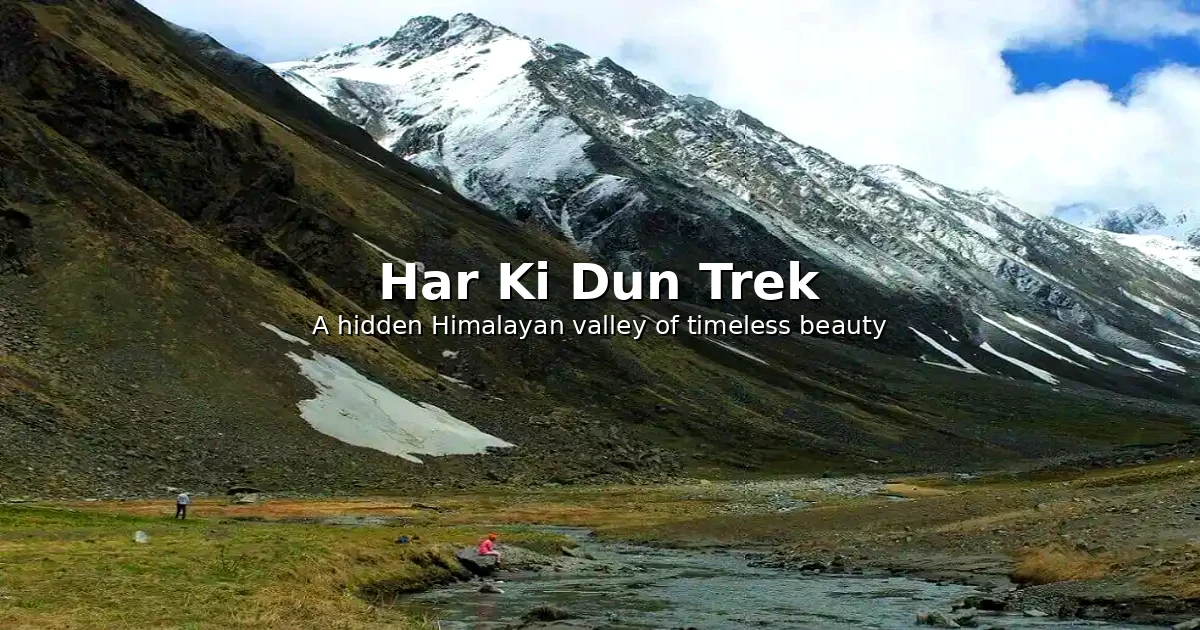
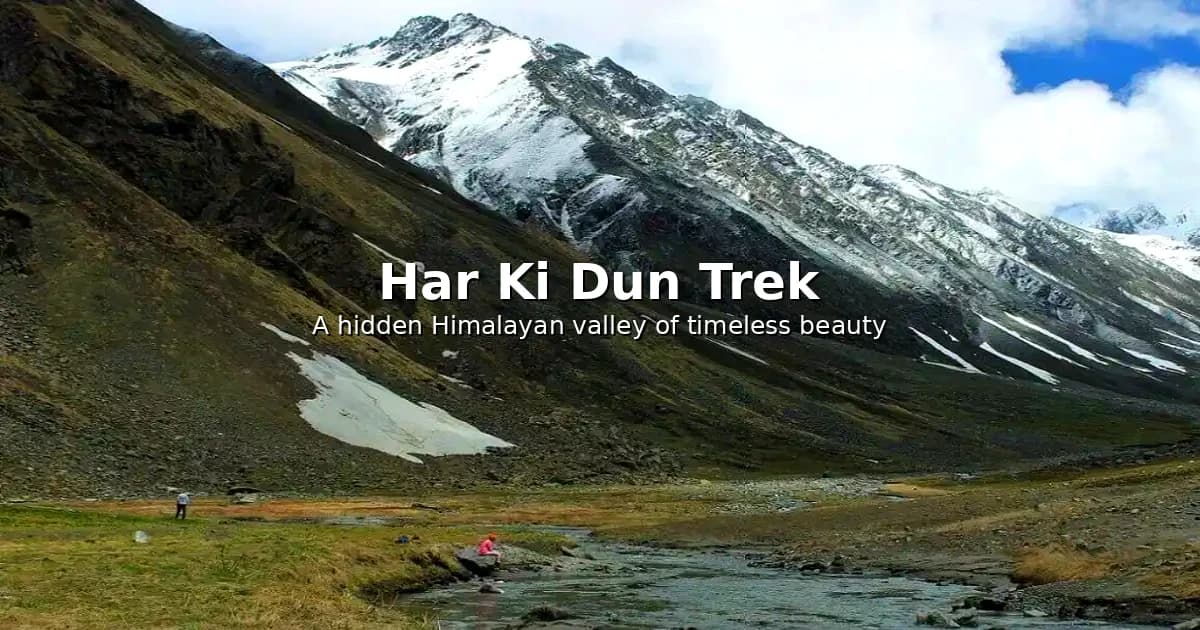

Har Ki Dun Trek
The Har Ki Dun Trek is one of the most scenic valley treks in Uttarakhand, known for its lush forests, river valleys and traditional mountain villages. Located in the Garhwal Himalayas, this trek follows an ancient route through the Supin River valley, offering views of snow-capped peaks, alpine meadows and wooden Himalayan villages. With its combination of natural beauty and cultural experiences, the Har Ki Dun Trek is often considered one of the best treks for beginners as well as experienced trekkers looking for a relaxed Himalayan journey.
Trek Summary
| Starting From | Dehradun | Ending at | Dehradun |
| No of days | 7 | Number of nights | 6 |
| Night stays at | Guest House (1N) Tent (4N) Guest House (1N) | ||
Har Ki Dun Trek Overview
The Har Ki Dun Trek typically spans 6 to 7 days and follows a gradual trail through the Supin River valley in Uttarakhand. The trek begins from Sankri and passes through dense forests, riverside trails and small Himalayan villages before reaching the Har Ki Dun valley.
Unlike high-altitude alpine treks, this route offers a mix of landscapes including pine forests, wooden houses and open valleys, making it one of the most diverse trekking experiences in the region.
Key Highlights of the Har Ki Dun Trek
Har Ki Dun valley: A wide Himalayan valley surrounded by snow-capped peaks
Traditional villages: Remote settlements with wooden houses and local culture
Supin River trails: Scenic riverside paths throughout the trek
Dense forests: Pine and oak forests along the route
Mountain views: Views of Swargarohini and surrounding peaks
Price Details
Trek Price
-
Trek price is ₹12,500 per person.
-
Prices vary depending on the departure batch.
-
Refer to the floating pricing panel for batch-wise pricing.
Har Ki Dun Trek Itinerary
Day 1: Drive from Dehradun to Sankri
190 km, 8 hrs
Meet at the starting point at Dehradun at 7:30 PM. After initial formalities, we will start our day with a drive to Sankri. The journey will pass through amazing views of mighty Himalayas. In the evening, reach Sankri. Checkin to a guest house and relax.
Overnight stay at a guest house.
Day 2: Drive from Sankri to Gangad and Trek to Osla
1 to 1.5 hours drive, 4-5 km trek, 6,725 ft - 8,270 ft
After breakfast, we board an SUV and drive through a bumpy road. We reach the village of Taluka in about an hour, which is the trek starting point.
We walk close to the river Supin gushing through rapids. Under the shade of walnut, pine, and cedar trees, the walk is quite pleasant. In autumn we can often find walnuts lying around. One must avoid “bichchu ghas” which literally translates to ‘scorpion grass’. A slight touch can give us a stinging sensation which lasts for about twenty to thirty minutes. This herb is also cooked as a vegetable and eaten. Often the passing villagers greet us on the way. High up above on the true left, we get to see the village of Datmer. It is lined by a series of step farms. The farms have the bright red colored Cholai growing from late monsoon to early autumn.
We continue our trek and soon we reach the secluded campsite.
Overnight stay at a camp on twin-sharing basis.
Day 3: Trek from Osla to Kalkatidhar
5-6 km / 8,270 ft - 10,830 ft
Today we start the day by heading up towards Osla village, which is located on a sloping spur about a hundred meters above the river Supin. The initial trail to Osla is the steepest section along the entire trek and can take 30-40 mins to cover. The landscape surrounding Osla is full of terraced farms. The colors of these lands differ in every season. The red farms of Cholai (Amaranth) look amazing and can be seen from the late monsoon.
This grain is a powerhouse with its rich nutritional values and a favorite among the locals. Apart from these Kidney beans in wide varieties are cultivated in the area. Osla is the last village on the route to Har ki Dun. From Osla the trail gradually rises higher and we cross a few fields, while the river can be seen far below. We come across a temple some distance below the trail towards the right. We pass through bushes of flowers like orchids, fleece flowers and sunflowers.
The journey today is rather short, which gives the opportunity to acclimatize to the high altitude and prepare for the next days journey. We can take a breather basking in the sun at the beautiful campsite of Kalkatidhar. The ban to camp at Har Ki Dun has had a rather positive outlook to the trekking itinerary, as it allows for more comfort & at the same time preserves the natural beauty of Har Ki Dun.
Overnight stay at a camp on twin-sharing basis
Day 4: Trek form Kalkatidhar to Har ki Dun & Marinda Tal, return to Boslo
10.5 km, 5-6 hrs / 9,977 ft to 11,600 ft to 10,412 ft
The day's trek can be considered to be rather long as we today visit Har Ki Dun and Marinda Tal, a small lake formation due to the obstructing boulder across the river stream, which lies 2 KM further ahead of Har Ki Dun. As we start the trek, at a short distance a hidden and roaring waterfall is encountered with a small tea shop beside the waterfall.
The ascending path offers stunning views above the confluence of the Supin and Ruinsara rivers. From here, you can admire the snow-clad peaks of Ruinsara Valley, notably Black Peak, the highest in the area. To the north, the Har Ki Dun valley unfolds in the distance, with a clear view of the Forest hut. Continuing higher on the right of the river, you enter a final stretch through a beautiful forest. Emerging from the woods, you arrive at Har Ki Dun’s main camping area, nestled beside a babbling stream. This panoramic spot sits at the junction of two valleys, one originating from Jaundhar Glacier and the other beyond Hata Glacier, offering a breathtaking natural spectacle.
We can choose to relax and soak in the environment for some time or we can continue our trek to Marinda Tal, in the north, just 2-3 km away from Har ki Dun. The trail is gradually ascending here. It is a small lake formed by a huge boulder obstructing the river which flows down from the base of the Borasu Pass.
After our short visit to Marinda Tal we make our return journey back to Kalkatidhar. We take the same route and it becomes much easier as its all downhill from here. We reach back by early evening and rest at the campsite.
Overnight stay at a camp on twin-sharing basis.
Day 5: Trek from Boslo to Devsu Thatch
5.1 km, 4-5 hrs / 10,502 ft to 9,878 ft
The journey back to Osla is an easy walk. On the route we come across a good view of the trail all the way to Osla and see the valley descend towards Taluka, around the curve of the ridge where the two streams comng from Har Ki Dun and Ruinsara respectively, converge. A little short of this intersection we can get a glimpse of a trail to our left marked by a sight of a bridge down over the stream.
This trail goes to join the trail to Ruinsara lake and is rarely taken. After reaching Osla, one can roam about in the village, talk to locals and soak in the Garhwali culture. We continue our journey from here to our earlier campsite of Puani Garat where we can spend time basking in the sun.
Overnight stay at a camp on twin-sharing basis.
Day 6: Trek from Devsu Thatch to Gangad, Drive to Sankri
7-8 km, 5-6 hrs / 9,878 ft to 7,709 ft to 8,265 ft
Early in the morning, post breakfast we set out from this beautiful abode as we start trekking through the same trail we trekked along on Day 1, towards Taluka. Although the views seem different as the perspective changes significantly trekking downhill. The walk takes lesser time than before and is enjoyable. We walk to the true left of the River Supin until we finally arrive at Taluka, from where a vehicle takes us back to Sankri. We retire for the day in camp alongside the river or in a guest house in Sankri.
Day 7: Drive from Sankri to Dehradun
190 km, 8 hrs
The trek to Har ki Dun concludes today as we leave Sankri. The drive up to Mori through the unique lesser-touched regions is still amazing. The stretch right after crossing Mori town is still the prettiest along the entire journey, albeit the new hydel project has put the fragile environs at increased risk in this area. Rafting and Kayaking which was earlier prevalent here are no longer feasible. Regardless the beauty of the region remains to a significant degree. After crossing the towns and finally Kempty-Mussoorie, we reach Dehradun by late afternoon or early evening.
Why Har Ki Dun Trek Is One of the Best Valley Treks
The Har Ki Dun Trek is unique because it combines natural beauty with cultural experiences. Trekkers walk through remote villages that still follow traditional lifestyles, offering a glimpse into the local Himalayan way of life.
The trail runs along the Supin River, with scenic bridges, forest paths and gradual ascents. The valley opens up near Har Ki Dun, offering wide views of surrounding peaks and alpine landscapes.
Trek Difficulty Level
The Har Ki Dun Trek is generally considered a moderate trek, suitable for beginners with basic fitness as well as experienced trekkers.
The route involves gradual ascents and well-defined trails, making it less demanding than high-altitude alpine treks like the Kashmir Great Lakes Trek.
Best Time to Do the Har Ki Dun Trek
The best time for the trek is
March to June: Pleasant weather with greenery and blooming flowers
September to November: Clear skies and excellent mountain views
Winter treks are also possible, offering snow-covered landscapes, though conditions can be colder and more challenging.
How Many Days Are Needed for the Har Ki Dun Trek?
Most itineraries span 7 days, which allows for a comfortable pace with enough time to explore the valley and surrounding areas.
Starting Point of the Har Ki Dun Trek
The trek typically starts from Sankri, a small village in Uttarakhand that serves as the base for several trekking routes in the region. Sankri is accessible by road from Dehradun.
Who This Trek Is Ideal For
Beginners looking for their first Himalayan trek
Nature lovers interested in valley landscapes
Trekkers who enjoy cultural experiences and village routes
Families and small groups seeking a moderate trek
Preparation for the Har Ki Dun Trek
Trekkers should prepare with regular walking, light hiking or cardio exercises before the trek. Proper trekking shoes, warm clothing and rain protection are essential due to changing mountain conditions.
Kedarkantha Trek in Winter (Snow Trek Experience)
The Kedarkantha Trek is most popular during winter, when the entire route is covered in snow. From dense forests to open campsites, the landscape transforms into a white winter environment.
Trekkers walk through snow-covered trails, camp in snowy clearings and experience clear skies with stunning mountain views. The summit climb during winter offers one of the most rewarding experiences, making Kedarkantha one of the best snow treks in India.
Important Points for Har Ki Dun Trek
Keep a day of buffer before booking your return flight/train ticket (to account for any delays due to weather or otherwise.
You will be out of mobile network area for all days of the trek. Please inform your loved ones that you will be lost in the most beautiful part of the world for next few days.
If you experience any symptoms of High Altitude Sickness (also known as Acute Mountain Sickness), please inform the trek lead immediately. Do not ignore the symptoms.
Being hydrated during the trek is the mantra. Practise drinking enough water to keep yourself hydrated. It will also help reduce the symptoms of high altitude sickness.
What to pack for Har Ki Dun Trek?
Non-skid, deep treaded, high-ankle trekking shoes
Pair of lightweight Slipper/Sandals
Quick Dry Warm lower or Track Pants (2)
Full sleeves T-shirts / Sweatshirts (1 for every 2 days of trekking)
Pair of thick woollen socks (1 pair for every two days of trekking)
Thermal Body warmer Upper & Lower
Undergarments / Innerwear (1 for every day of trekking)
Warm jacket closed at wrist & neck (1)
Full sleeves sweater (1)
Rain wear (Jacket & Pants)
Pair of waterproof warm gloves (1)
Woolen cap (1)
Sun shielding Hat (1)
Rucksack bag with rain cover (1)
Day Pack Bag - Recommended for treks with summit days
Head Torch / Flashlight with spare batteries (mobile flashlight will not be enough)
UV protection sunglasses
Water Bottle (2) (1 litre each)
Utensils: Small size, Lightweight & Leak proof lunch box
Plate, Spoon, Coffee/Tea Mug
Your regular medicines and few others for emergency (if any)
Dry Fruits, snacks, soft drinks etc
Documents: Government issued Address Proof (Voter ID, Aadhaar, Driver's License, Passport) (mandatory)
Documents: Doctor's Certificate (mandatory)
Documents: Signed Disclaimer Form (will be shared before trekking) (mandatory)
What is included in the price?
Transport from Dehradun to Campsite on first day
Transport from campsite to Dehradun on last day
All meals during the trek (breakfast, lunch, evening snacks, dinner) - starting from dinner on day 1 to breakfast on day 7
Accommodation on twin sharing basis at camps from Day 1 to Day 6
Highly Experienced Trekking Guide
Kitchen tents, toilet tents, sleeping tents, sleeping bags etc
Hot water for drinking purpose shall be provided on request.
Kitchen, dining and toilet tents will be used during the trek.
Cooks/Helpers for carrying common equipment like rations / tents / utensils / groceries
Skilled local staff who have ample knowledge of the route.
Accommodation - tents, sleeping bags, sleeping mats etc
Safety equipment - as per requirements and basic first aid kit with a portable oxygen cylinder
Permit - forest and camping fee included.
What are excluded from the price?
Airfare / flight tickets, train tickets, bus tickets etc.
Accommodation outside of camps
Baggage offloading charges / porter or mule charges
Travel Insurance
Anything not mentioned in inclusions
Starting From
₹12500
Per Person


